


While these factors can have a significant impact in the short term, their importance diminishes when viewed from a long-term perspective. Over an extended horizon, one factor tends to dominate all others in determining a stock’s trajectory: earnings per share (EPS) growth. I therefore propose exploring this concept through a few examples of Canadian stocks.
To simplify my examples, we will use EPS as the reference metric, although free cash flow may be an even more relevant measure. Regardless of the metric used, the conclusion is the same: over the long term, a stock’s price will follow the growth of its EPS.
Alimentation Couche-Tard
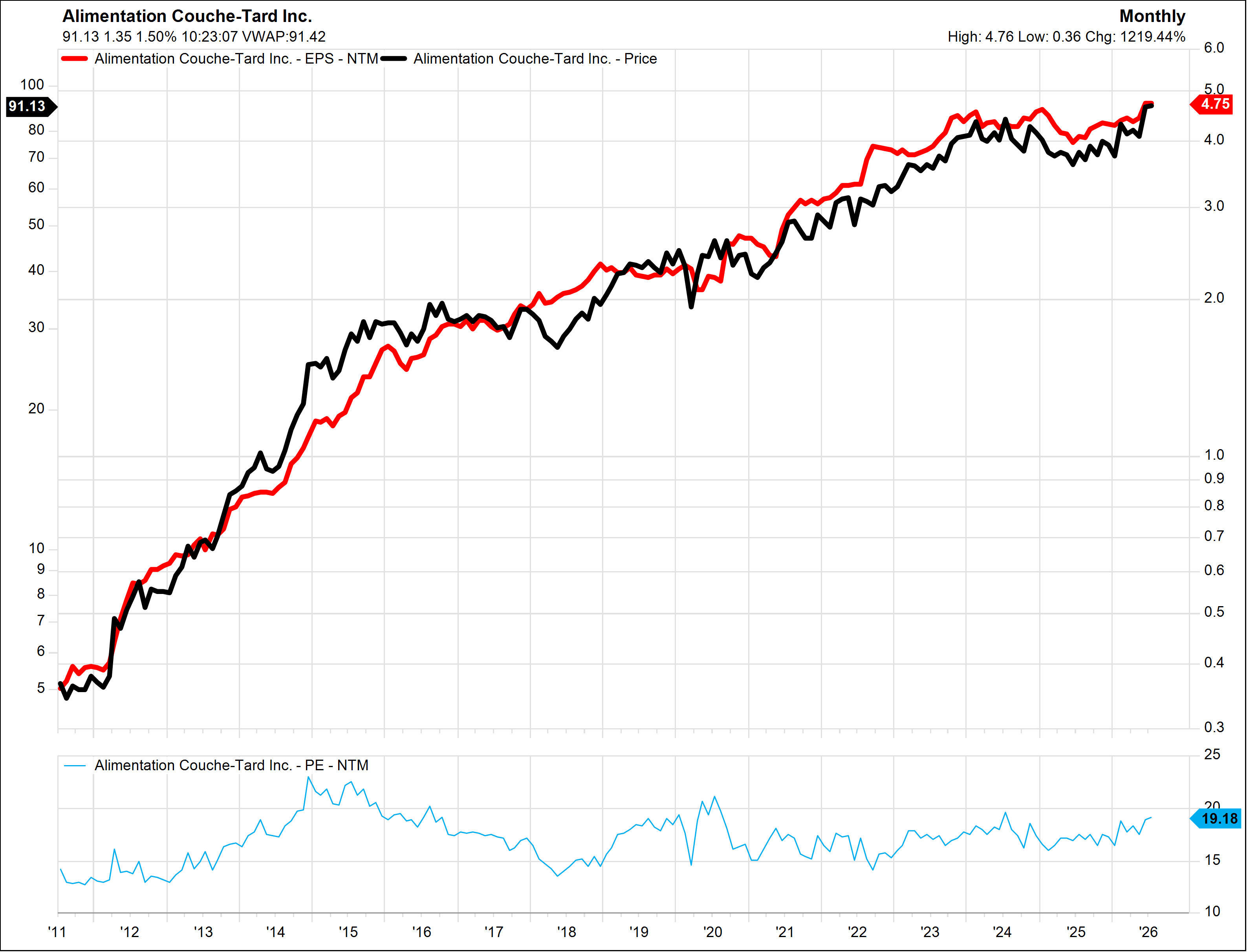
Over the past fifteen years, Couche-Tard’s EPS have grown at a compound annual rate of 19%, while the stock has appreciated by 21% over the same period. In the (logarithmic) charts below, you will find the evolution of forecast EPS shown in red. In black, you can observe the stock price. Below, I have also added the forward price-to-earnings ratio. Couche-Tard is a typical example where, over the long term, a stock’s price follows the growth of its EPS.
Stantec
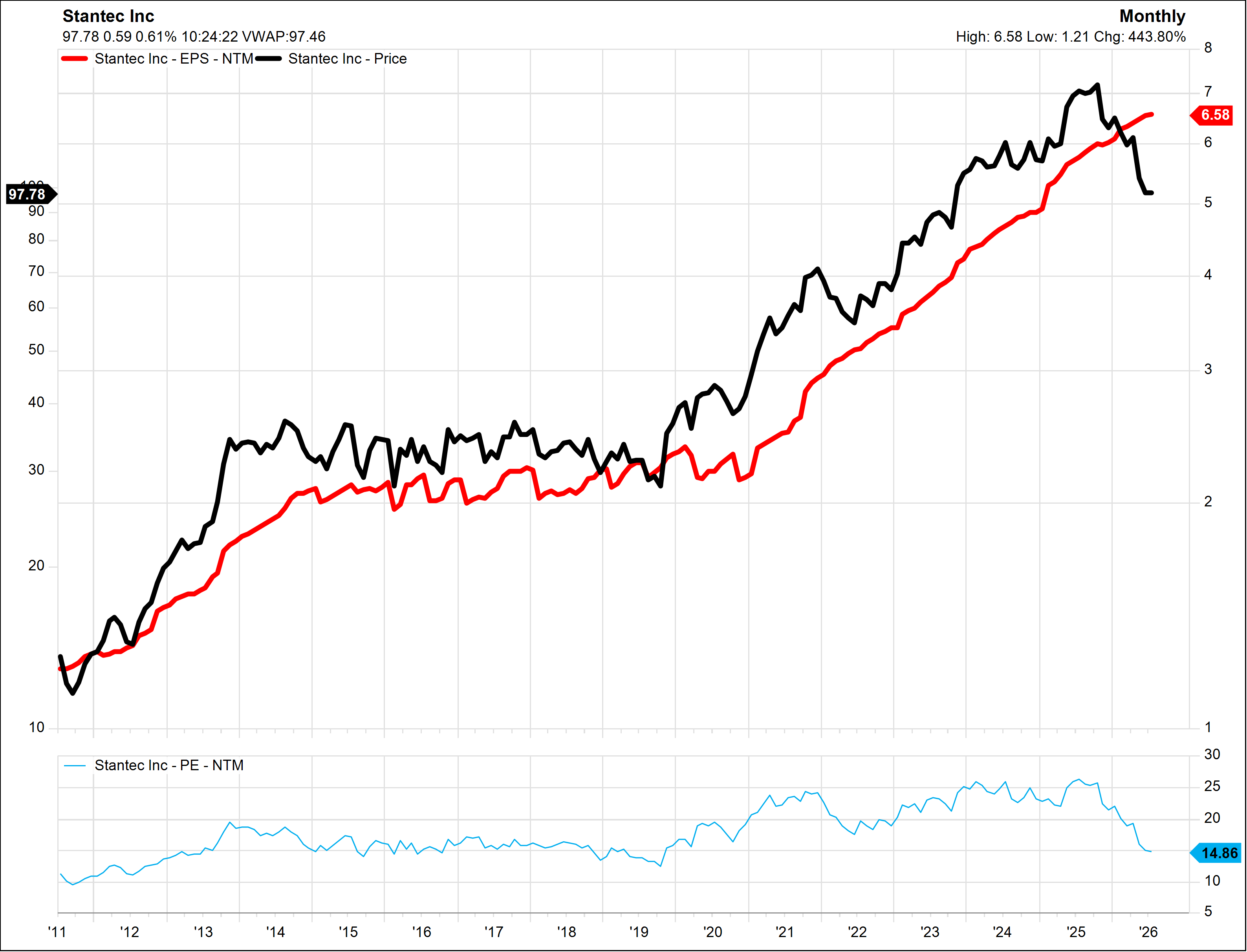
Looking at Stantec, we can see that EPS showed no growth between 2014 and 2019. During that period, the stock also went nowhere. After that episode, EPS growth resumed, as did the stock price. Over fifteen years, EPS grew by 12%, while the stock advanced by 14%. Over the long term, a stock’s price will tend to track the growth of its EPS quite closely.
Shopify
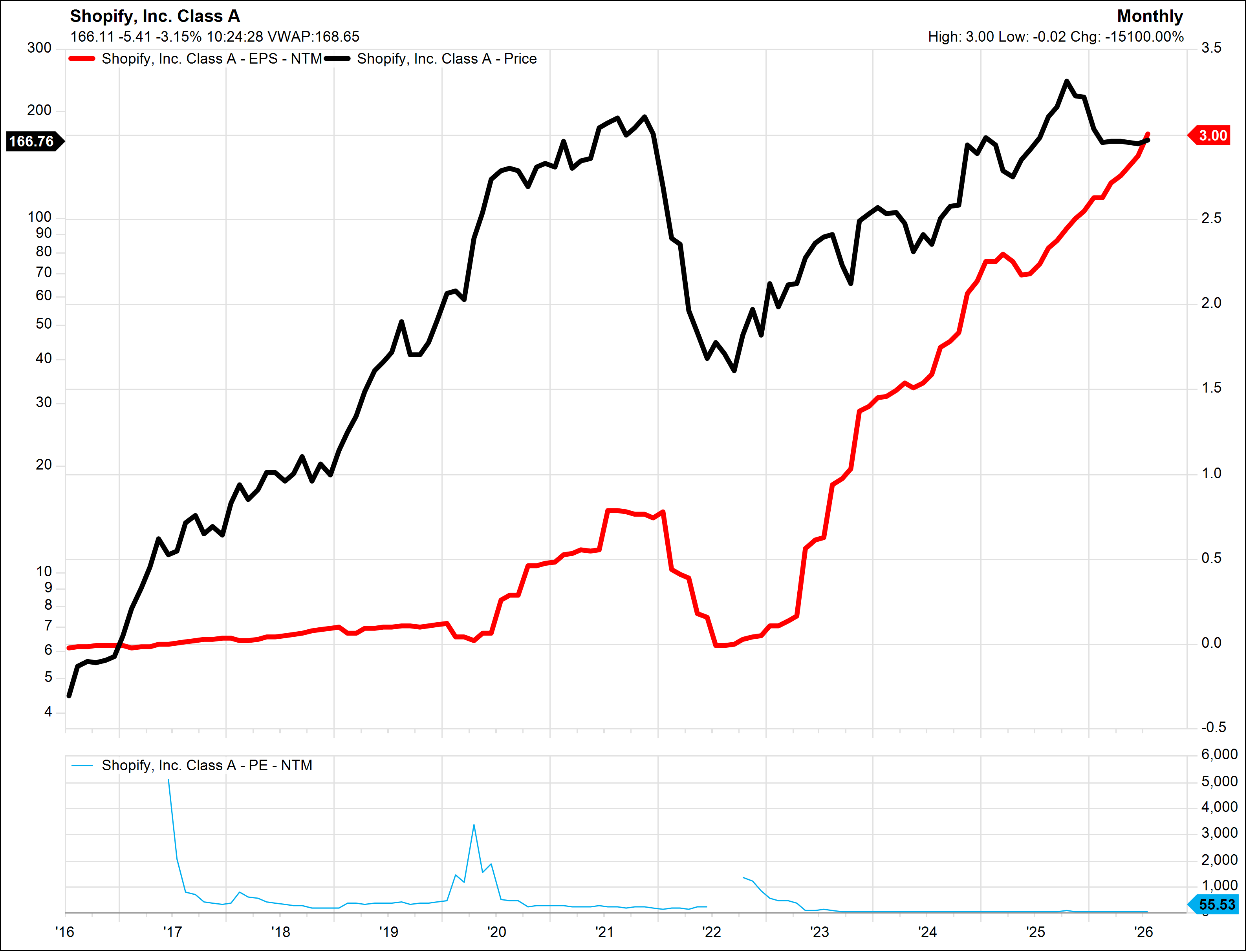
For years, Shopify’s EPS were negligible because of its substantial investments in its platform. Yet investors were willing to pay more than 300 times earnings. Why? Because they expected EPS to increase substantially in the years ahead. We can see that those early investors were right.
BCE
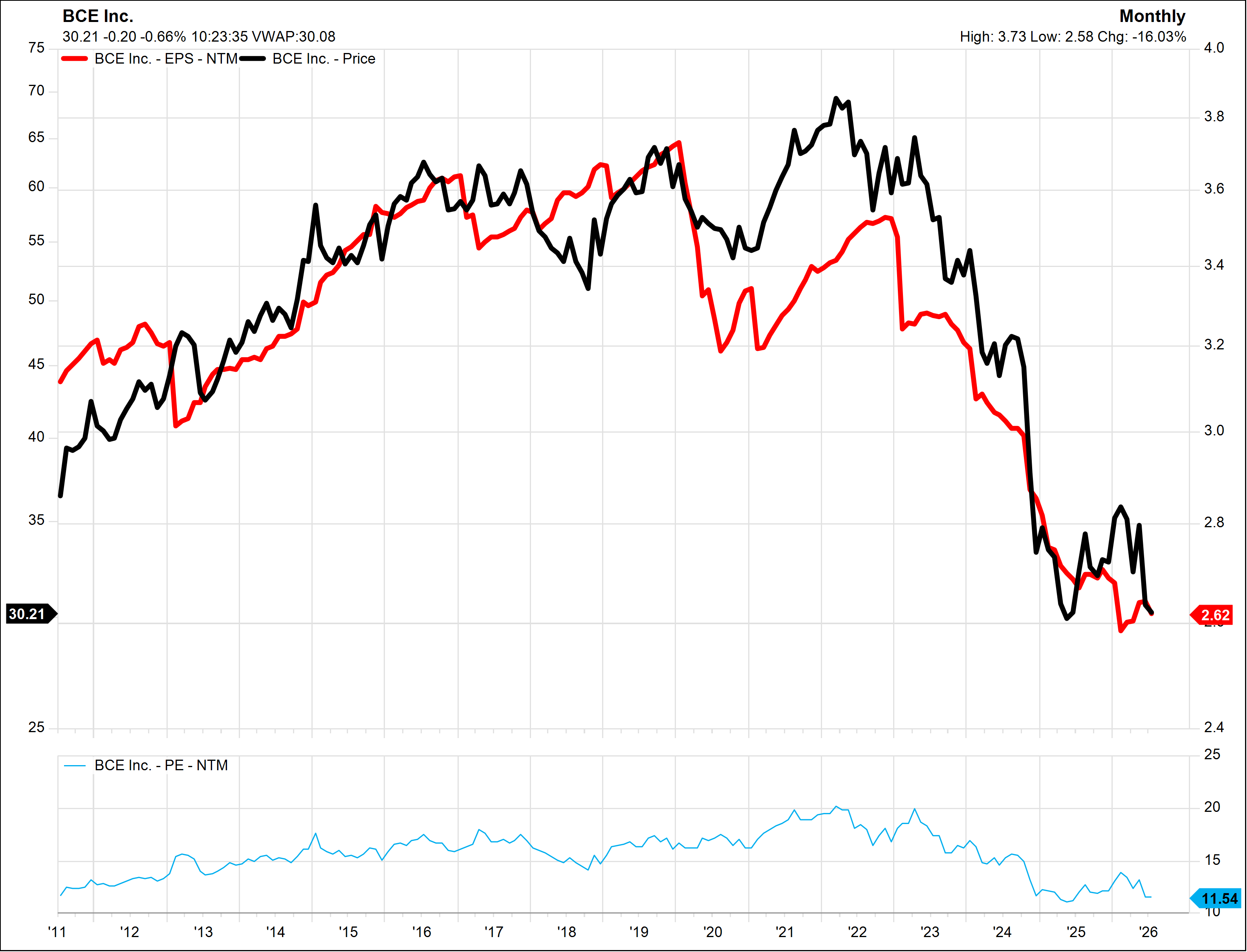
BCE represents the opposite of the previous examples. On the chart, we can see that EPS are lower today than they were 15 years ago. This is another clear example that, over the long term, a stock’s price will follow the growth of its EPS, both on the upside and the downside.
The Investor’s Job
An investor’s first job is therefore to identify the external and internal factors that will enable a company to increase its EPS over the long term. Is the company’s business model protected by significant barriers to entry? Have management teams allocated capital effectively in the past? Where will future growth come from? How will the company adapt to a constantly changing environment, particularly in terms of technology? A lengthy process of analysis and research is required to answer these and many other questions. Ultimately, the stronger the growth and the longer it lasts, the more likely the stock is to be successful over the long term.
An investor’s second job is to ensure that they pay an appropriate price. In the stock market, nothing is guaranteed and nothing is linear. A company with promising prospects may fail to deliver on them. Strong EPS growth could be compromised in the future. It is even possible that EPS will begin to decline. The price paid is therefore important in helping reduce risk.
As Warren Buffett once said: « Investing is simple, but not easy. » It is simple because, regardless of what happens in the short term, a stock’s price will follow the growth of its EPS over the long term. But investing is difficult because it requires a great deal of analysis and thought, while the risk of making mistakes is always present: it is not easy to predict the future and determine an appropriate price based on expected growth.
Jean-Philippe Legault, CFA
Senior Portfolio Manager at COTE 100
_______
This article is also published on  (in French)