


When we explain our investment philosophy to clients, we emphasize that we follow a concentrated approach, selecting between 25 and 30 stocks for our portfolios.
The decision to hold 25 to 30 stocks is not arbitrary. It is largely based on mathematical reasoning. Here is that reasoning.
In the stock market, there are two types of risk: company-specific risk and market risk. Put simply, whether you own five stocks or one hundred, market risk can hardly be diversified away. You must face it regardless of your portfolio’s composition. However, company-specific risk can be reduced through diversification.
To illustrate this concept, I analyzed the stock market performance of the 503 companies in the S&P 500 over the past ten years. I then simulated hundreds of portfolios of different sizes using various random combinations of equally weighted stocks. For each portfolio, I analyzed the interaction among the stocks using a covariance matrix. In other words, I measured how the movement of one stock follows or diverges from the others.
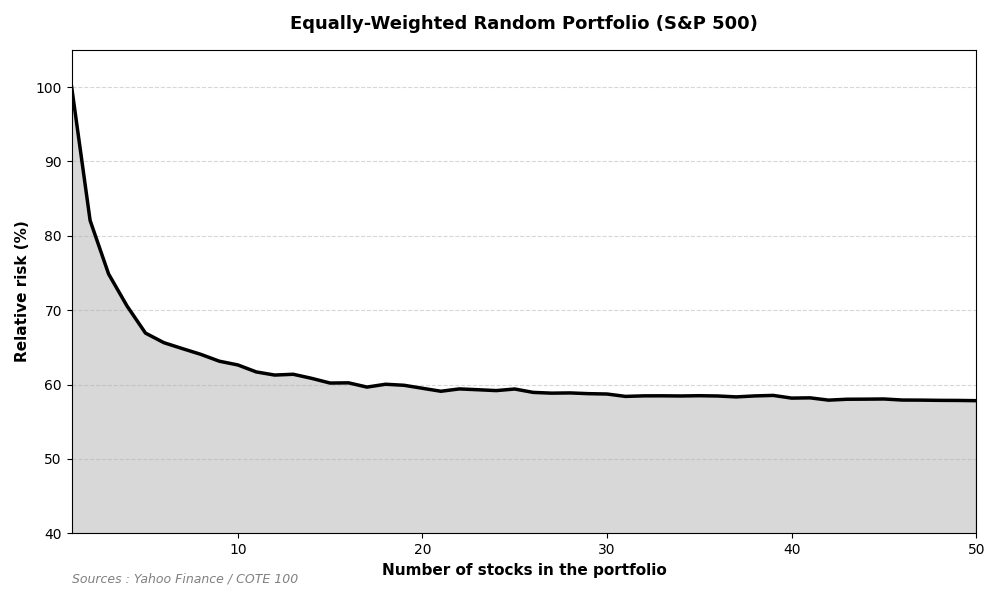
As expected, a portfolio consisting of a single stock carries a relative risk of 100%, since there is no diversification. The benefits of diversification become apparent as soon as a second stock is added, reducing relative risk to 82%. Relative risk declines further, reaching 75% when a third stock is added.
Looking at the chart above, we can see that most of the diversification benefit is achieved relatively quickly, with the curve flattening around 20 to 30 stocks. Beyond that point, the curve becomes nearly flat, and adding another stock provides very little additional diversification.
The conclusion of this analysis is that it is not necessary to hold a large number of stocks to achieve adequate diversification.
However, an important clarification must be made. The analysis above was obtained by constructing equally weighted portfolios using stocks randomly selected from the entire S&P 500. Ignoring each stock’s weight within the index, we can reasonably conclude that this represents a diversified pool of companies.
The concept of diversification would not hold up if the selected stocks all belonged to the same sector and behaved in a relatively similar manner.
A good example of this is an analysis I conducted using Canada’s six major banks.
If I repeat the same exercise, it becomes clear that the relative risk of a portfolio consisting solely of the six major Canadian banks is 89%, which provides very little diversification.
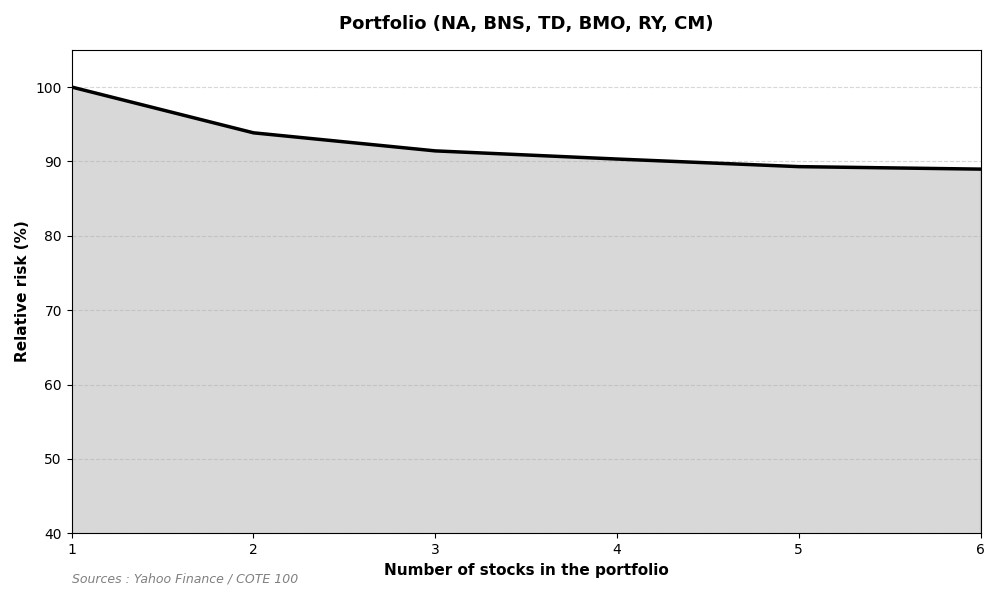
Thus, a portfolio consisting of six stocks randomly selected from the S&P 500 will be far better diversified than a portfolio made up exclusively of the six major Canadian banks. The relative risk of the former is 66%, compared with 89% for the portfolio containing only banks.
I would therefore revise the conclusion of my analysis by saying that it is not necessary to hold many stocks to achieve adequate diversification, if the correlation among them remains relatively low.
Of course, all of this is highly theoretical. The true diversification of a portfolio should be assessed by examining the actual holdings and their respective weights. In practice, portfolio construction is not a matter of chance but rather the result of rigorous analysis.
The primary objective of this article is to demonstrate why it is mathematically reasonable to argue that a portfolio of 25 to 30 stocks, spread across companies from different sectors, is generally adequately diversified.
Jean-Philippe Legault, CFA
Senior Portfolio Manager at COTE 100
_______
This article is also published on  (in French)